Hue Gradient Lightstrip Review: Pricey, Polished
Published: July 9, 2026
We independently test everything we recommend.
Buying through links on our site supports our work.
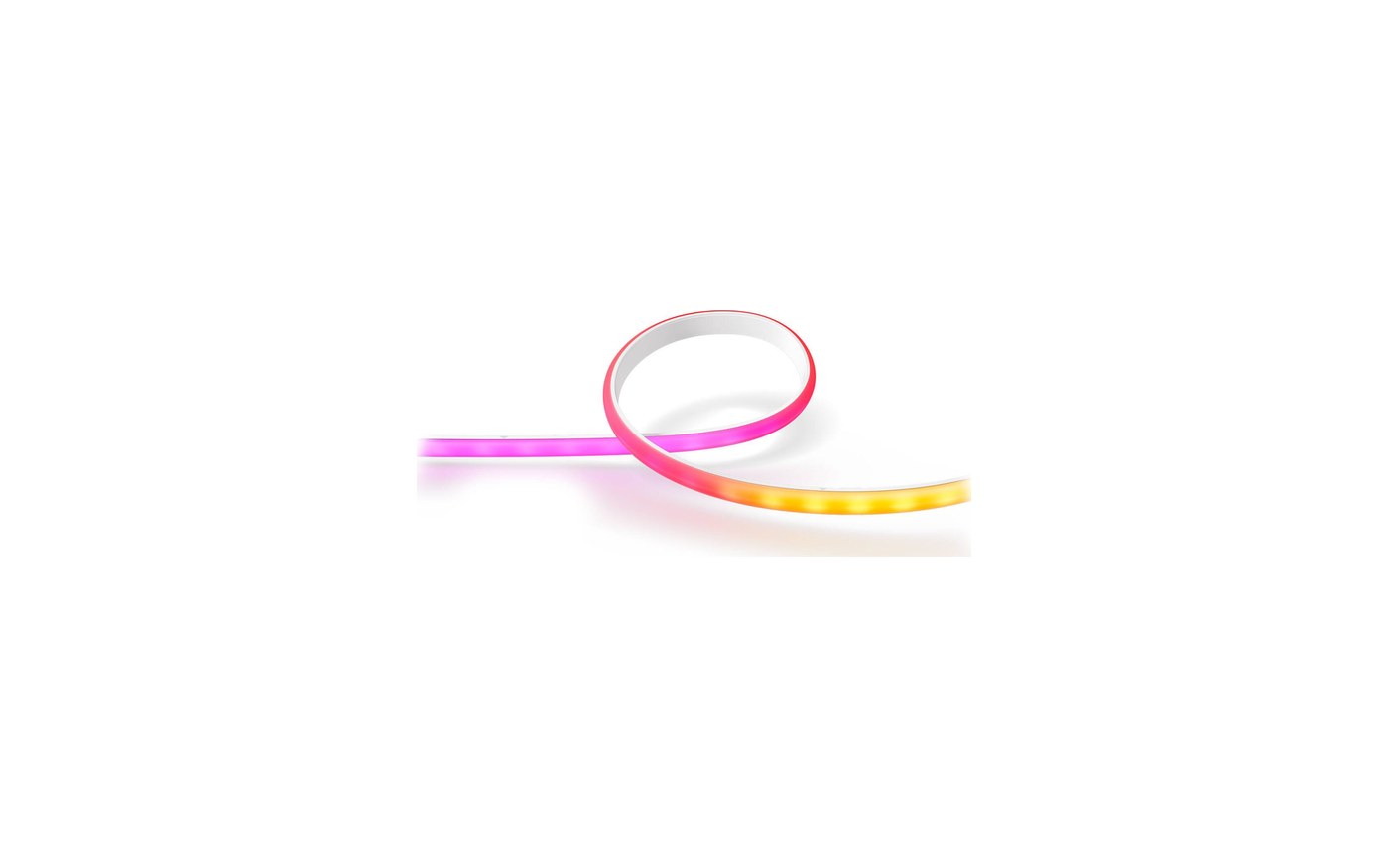
Editor's Note: Tested six weeks behind a 65-inch TV and two weeks on an open shelf, driven by a Hue Bridge over Thread alongside 14 other Hue lights.
The Philips Hue Ambiance Gradient Lightstrip costs $180 for 80 inches. The Govee M1 costs $80 for 16 feet. If you stopped reading here, you'd buy the Govee and be happy, and honestly, most people should do exactly that. The rest of this review is about the specific household for whom the math flips.
What does 'better blending' mean in a real room?
Govee's strips render gradients as segments doing a good impression of a blend; step close and you can find the boundaries. The Hue strip pours. Colors migrate along its length with no detectable zones, thanks to overlapping diffusion Signify clearly spent money on. Behind a TV at viewing distance, the difference is subtle. On an open shelf at eye level, it's the difference between a light strip and lighting. The housing is also fully diffused, so even the off state looks finished rather than like exposed circuit tape.
Why does the Bridge matter so much here?
Because integration is the actual product. With a Bridge, this strip stops being an accessory and joins the house: our single Movie Night tap dims the ceiling A19s, sweeps the Signe lamp amber, and rolls the strip to a low ember, in sync, over Thread, with zero dropouts in six weeks of nightly use. Without a Bridge you get a Bluetooth strip that does colors, and you've overpaid enormously for that. The no-cutting rule completes the commitment: measure twice, because 80 inches is what you get.
Specs, Pros & the Bottom Line
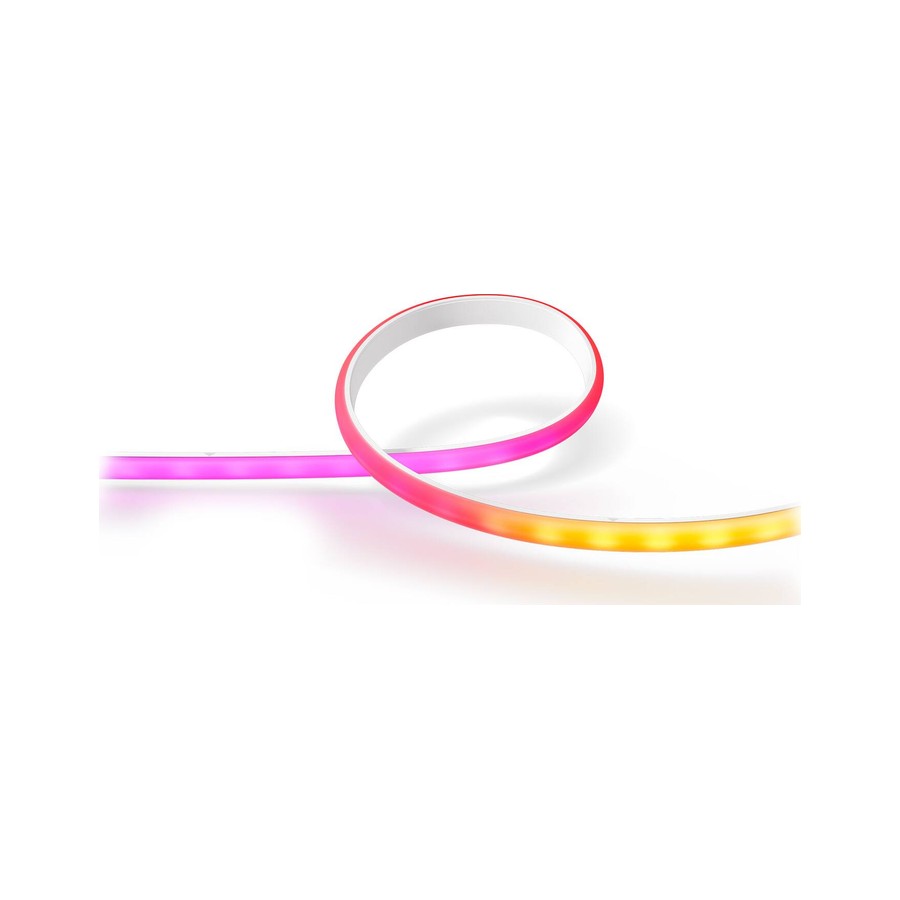
Philips Hue Ambiance Gradient Lightstrip
For Hue households that want the strip done right
- Our Rating: 4.1 / 5.0
- Price: $180 (80 in)
- Type: LED light strip
- Hub needed: Bridge required for full features
- Brightness: 1,800 lumens
- Matter: Yes (via Bridge)
- Ecosystems: Apple Home, Alexa, Google, SmartThings
- Length: 80 in (not cuttable)
Pros
- Gradient blending is visibly smoother than Govee's segment stepping
- Hue scenes treat it as one canvas with your other Hue lights
- Rock solid over Thread with a Bridge; six weeks, zero dropouts
Cons
- $180 buys 80 inches; the same money buys 65 feet of Govee M1
- Effectively Bridge-required, adding $60 if you're not already in
- Cutting it is not supported, which makes sizing unforgiving
Do the math before falling in love: per foot, this costs roughly eight times the Govee M1, it can't be cut to size, and without a Hue Bridge you're not getting the features that justify it. What the money buys is coherence. The gradient doesn't step between color zones, it pours. And inside a Hue home the strip stops being a separate gadget: one Bedtime scene fades the ceiling bulbs, the Signe lamp, and this strip as a single instrument. Six weeks over Thread, not one dropout. Buy it if you're already carrying the Bridge and want the TV wall to match the rest of the house. Buy Govee if you want maximum glow per dollar.
What to buy instead
For every non-Hue household, the Govee M1 at half the money and five times the length is the obvious answer. Inside a Hue home on a budget, one option nobody mentions: Hue's plain (non-gradient) lightstrip is $90, and behind a TV the gradient premium is the first thing you stop noticing.
The verdict
This is the best light strip we've tested and the worst value, and both facts are load-bearing. Buy it if the Bridge is already on your shelf, the location is measured, and the scene-sync life is why you're in Hue at all. Anyone still comparing brands should take the Govee and the $100.